tikatuwq: Water Quality Indices and Temporal Trends
tikatuwq developers
Source:vignettes/tikatuwq-methods.Rmd
tikatuwq-methods.RmdIntroduction
This vignette focuses on the methods implemented in tikatuwq for computing water quality indices and analyzing temporal trends. We cover:
- Water Quality Index (IQA/WQI) calculation methods
- Trophic State Index (IET) for lakes and reservoirs
- Temporal trend analysis using robust and parametric methods
- Parameter-specific analysis tools
Water Quality Index (IQA/WQI)
Method overview
The IQA combines sub-indices (Qi) for individual parameters using weighted arithmetic mean. The sub-indices are obtained by piecewise-linear interpolation over approximate curves (CETESB/NSF style).
Default parameters and weights
The default IQA implementation uses 9 parameters with standard weights:
Computing IQA
# Compute IQA with default settings
df_iqa <- iqa(wq_demo, na_rm = TRUE)

# View results
cols_show <- intersect(c("ponto", "IQA", "IQA_status"), names(df_iqa))
head(df_iqa[, cols_show, drop = FALSE])
#> # A tibble: 6 × 3
#>   ponto         IQA IQA_status
#>   <chr>       <dbl> <ord>
#> 1 FBS-BRH-250  89.8 Boa
#> 2 FBS-BRH-250  93.1 Otima
#> 3 FBS-BRH-250  92.2 Otima
#> 4 FBS-BRH-250  87.6 Boa
#> 5 FBS-BRH-250  95.7 Otima
#> 6 FBS-BRH-300  89.3 Boa

# Distribution
hist(df_iqa$IQA, breaks = 10, main = "IQA Distribution", xlab = "IQA")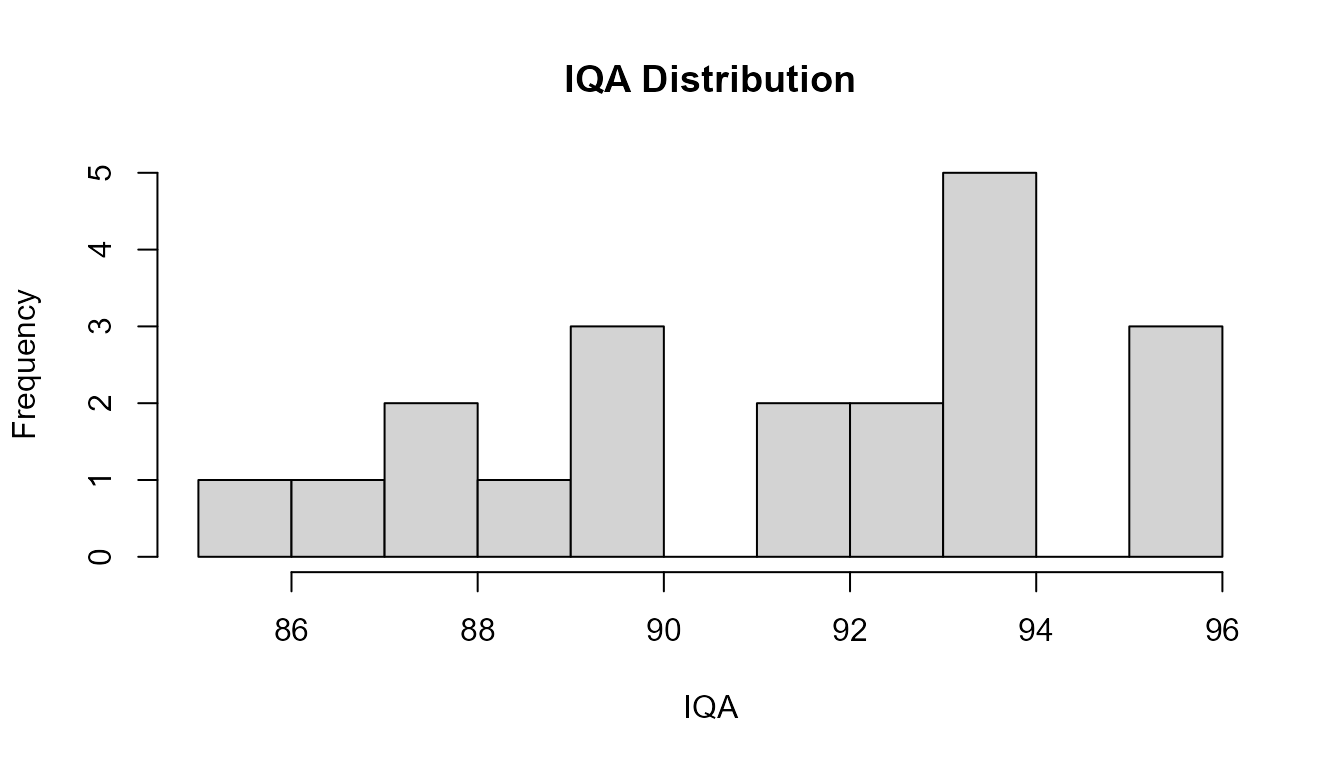
Handling missing parameters
When na_rm = TRUE, weights are rescaled per row to use
only available parameters:
Custom weights
You can provide custom weights:
# Custom weights (must sum to 1)
custom_weights <- c(
  od = 0.20,
  coliformes = 0.20,
  dbo = 0.10,
  nt_total = 0.10,
  p_total = 0.10,
  turbidez = 0.10,
  tds = 0.10,
  pH = 0.05,
  temperatura = 0.05
)

df_iqa_custom <- iqa(wq_demo, pesos = custom_weights, na_rm = TRUE)
cols_show2 <- intersect(c("IQA", "IQA_status"), names(df_iqa_custom))
head(df_iqa_custom[, cols_show2, drop = FALSE])
#> # A tibble: 6 × 2
#>     IQA IQA_status
#>   <dbl> <ord>
#> 1  92.4 Otima
#> 2  96.0 Otima
#> 3  95.2 Otima
#> 4  89.5 Boa
#> 5  99.1 Otima
#> 6  92.9 Otima
Classification
The IQA values are automatically classified into qualitative categories:
# Classification function
classify_iqa(c(15, 40, 65, 80, 95))
#> [1] Muito ruim Ruim       Regular    Boa        Otima
#> Levels: Muito ruim < Ruim < Regular < Boa < Otima

# English labels
classify_iqa(c(15, 40, 65, 80, 95), locale = "en")
#> [1] Very Poor Poor      Fair      Good      Excellent
#> Levels: Very Poor < Poor < Fair < Good < Excellent

# Distribution in demo data
table(df_iqa$IQA_status)
#>
#> Muito ruim       Ruim    Regular        Boa      Otima
#>          0          0          0          8         12
Trophic State Index (IET)
Carlson IET
For lentic systems, the Carlson Trophic State Index uses Secchi depth, chlorophyll-a, and total phosphorus:
# Example dataset with required parameters
# df_lake <- data.frame(
#   ponto = c("L1", "L2"),
#   secchi = c(2.5, 1.0),  # meters
#   clorofila = c(5, 20),  # ug/L
#   p_total = c(0.02, 0.10)  # mg/L (converted to ug/L internally)
# )
#
# iet_carlson(df_lake, .keep_ids = TRUE)
The function automatically: - Converts p_total (mg/L) to tp (ug/L) if needed - Accepts aliases (sd for secchi, chla for clorofila) - Returns TSI values with classification
Temporal Trend Analysis
Single parameter trend
The trend_param() function computes Theil-Sen slope and
Spearman correlation:
# Add temporal structure to demo data
df_temporal <- wq_demo
df_temporal$data <- as.Date("2025-01-01") + seq_len(nrow(df_temporal)) - 1

# Compute trend for turbidity
trend_result <- trend_param(df_temporal, param = "turbidez")

print(trend_result)
#>        rio       ponto    param n   date_min   date_max days_span
#> 1 BURANHEM FBS-BRH-250 turbidez 5 2025-01-01 2025-01-05         4
#> 2 BURANHEM FBS-BRH-300 turbidez 5 2025-01-06 2025-01-10         4
#> 3 BURANHEM FBS-BRH-450 turbidez 5 2025-01-11 2025-01-15         4
#> 4 BURANHEM FBS-BRH-950 turbidez 5 2025-01-16 2025-01-20         4
#>   slope_per_year intercept rho_spearman p_value      trend pct_change_period
#> 1             NA        NA           NA      NA indefinido                NA
#> 2             NA        NA           NA      NA indefinido                NA
#> 3             NA        NA           NA      NA indefinido                NA
#> 4             NA        NA           NA      NA indefinido                NA
The result includes: - slope: Theil-Sen slope -
p_value: Spearman correlation p-value - trend:
classification (increasing, decreasing, stable)
Plotting trends
library(ggplot2)

# Plot with trend line
p_trend <- plot_trend(df_temporal, param = "turbidez", method = "theilsen")
print(p_trend)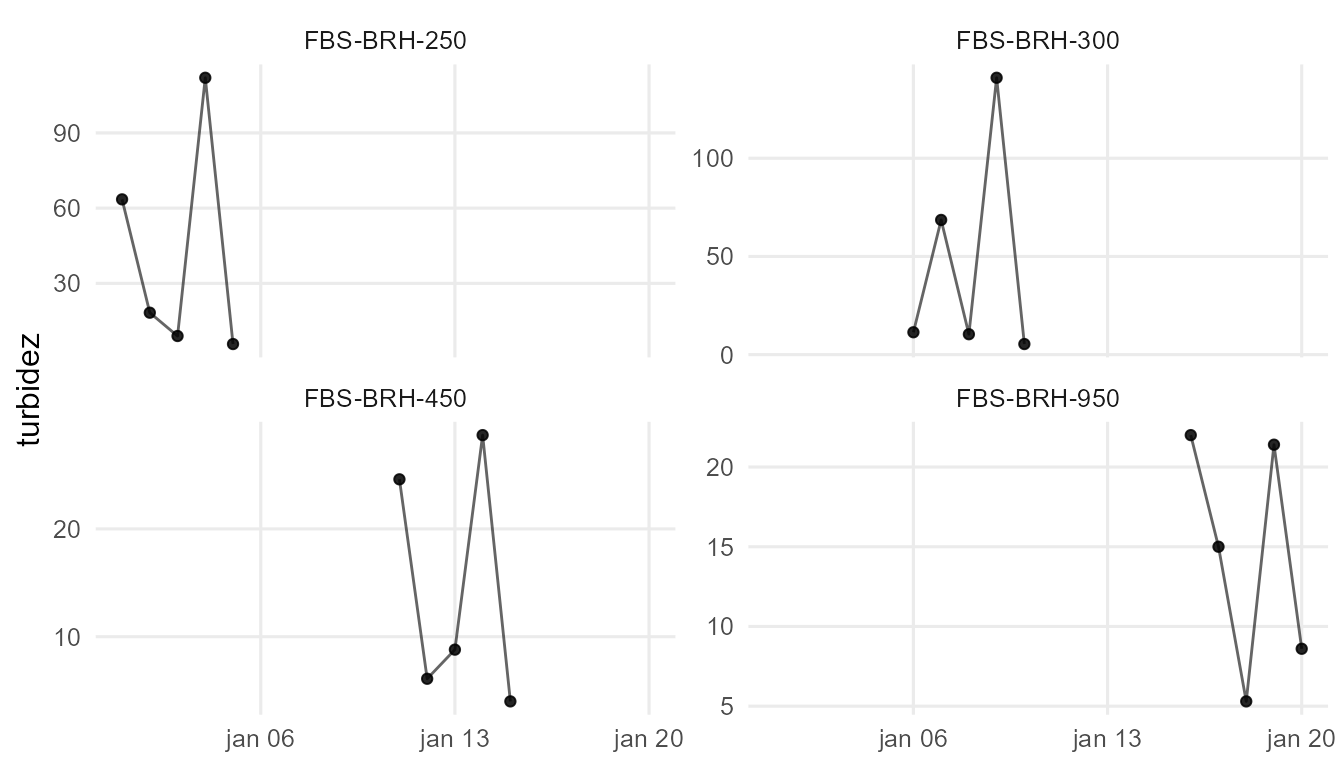
# With LOESS smoothing
p_loess <- plot_trend(df_temporal, param = "turbidez", method = "loess")
print(p_loess)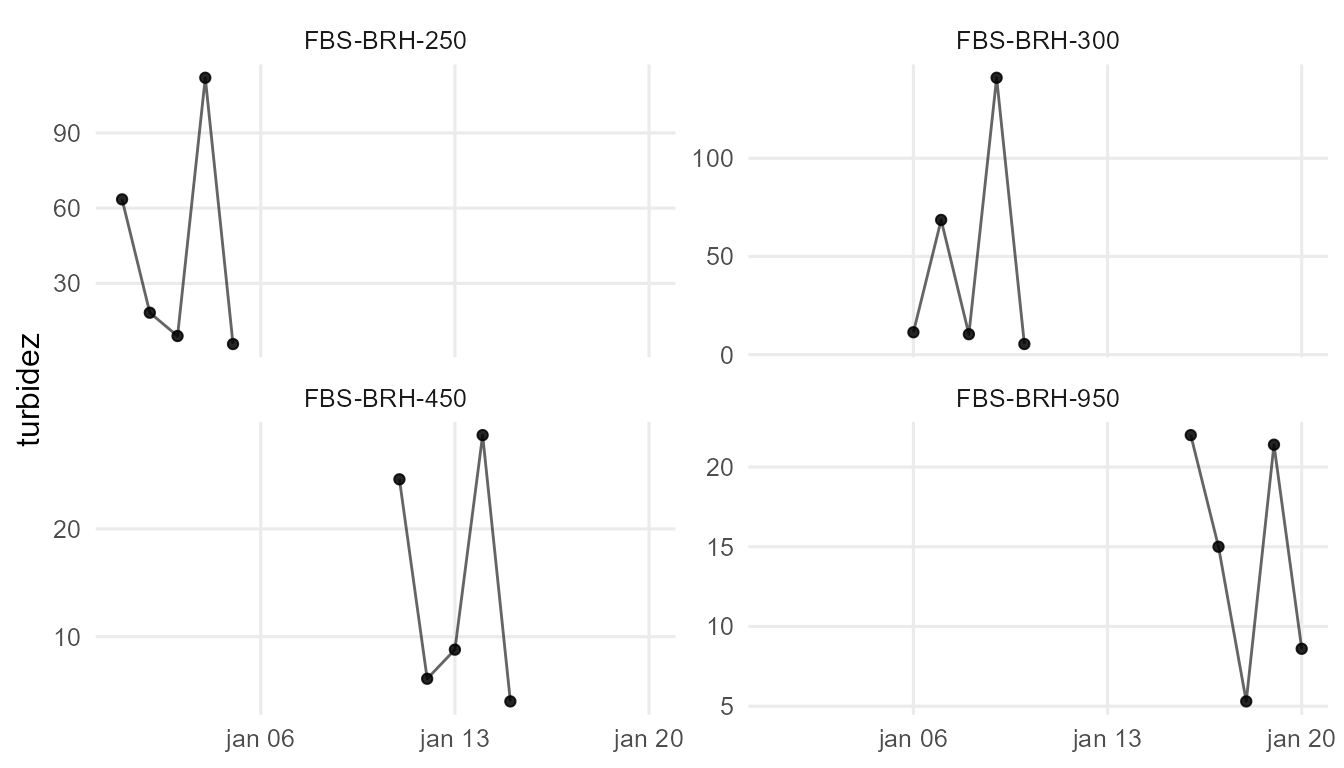
Multiple parameters
Use param_trend_multi() to analyze trends across
multiple parameters:
# Trends for multiple parameters
params <- c("turbidez", "od", "dbo")
trends_multi <- param_trend_multi(df_temporal, parametros = params)

print(trends_multi)
#> # A tibble: 12 × 7
#>    rio      ponto           slope p_value       r2     n parametro
#>    <chr>    <chr>           <dbl>   <dbl>    <dbl> <int> <chr>
#>  1 BURANHEM FBS-BRH-250 -2.17e+ 0  0.904  5.66e- 3     5 turbidez
#>  2 BURANHEM FBS-BRH-300  6.04e+ 0  0.793  2.67e- 2     5 turbidez
#>  3 BURANHEM FBS-BRH-450 -1.86e+ 0  0.674  6.69e- 2     5 turbidez
#>  4 BURANHEM FBS-BRH-950 -2.04e+ 0  0.468  1.86e- 1     5 turbidez
#>  5 BURANHEM FBS-BRH-250  2.54e- 1  0.286  3.58e- 1     5 od
#>  6 BURANHEM FBS-BRH-300  2.20e- 1  0.253  4.00e- 1     5 od
#>  7 BURANHEM FBS-BRH-450 -4.43e- 1  0.199  4.74e- 1     5 od
#>  8 BURANHEM FBS-BRH-950 -5.85e- 1  0.478  1.79e- 1     5 od
#>  9 BURANHEM FBS-BRH-250  2.91e-14  1.000  1.04e-26     5 dbo
#> 10 BURANHEM FBS-BRH-300 -9.00e- 1  0.0577 7.50e- 1     5 dbo
#> 11 BURANHEM FBS-BRH-450 -6   e- 1  0.182  5.00e- 1     5 dbo
#> 12 BURANHEM FBS-BRH-950  1.99e-16  0.182  5.00e- 1     5 dbo
Parameter-specific Analysis
Summary statistics
# Summary for one parameter
summary_turb <- param_summary(df_temporal, parametro = "turbidez")
print(summary_turb)
#> # A tibble: 4 × 8
#>   rio      ponto           n  mean    sd   min median   max
#>   <chr>    <chr>       <int> <dbl> <dbl> <dbl>  <dbl> <dbl>
#> 1 BURANHEM FBS-BRH-250     5  41.7 45.6    5.8   18.3 112
#> 2 BURANHEM FBS-BRH-300     5  47.4 58.4    5.4   11.4 141
#> 3 BURANHEM FBS-BRH-450     5  14.4 11.4    4      8.8  28.7
#> 4 BURANHEM FBS-BRH-950     5  14.5  7.48   5.3   15    22

# Multi-parameter summary
summary_multi <- param_summary_multi(df_temporal, parametros = c("turbidez", "od", "dbo"))
print(summary_multi)
#> # A tibble: 12 × 9
#>    rio      ponto           n  mean     sd   min median    max parametro
#>    <chr>    <chr>       <int> <dbl>  <dbl> <dbl>  <dbl>  <dbl> <chr>
#>  1 BURANHEM FBS-BRH-250     5 41.7  45.6    5.8   18.3  112    turbidez
#>  2 BURANHEM FBS-BRH-300     5 47.4  58.4    5.4   11.4  141    turbidez
#>  3 BURANHEM FBS-BRH-450     5 14.4  11.4    4      8.8   28.7  turbidez
#>  4 BURANHEM FBS-BRH-950     5 14.5   7.48   5.3   15     22    turbidez
#>  5 BURANHEM FBS-BRH-250     5  6.44  0.671  5.96   6.13   7.58 od
#>  6 BURANHEM FBS-BRH-300     5  6.84  0.550  6.19   6.7    7.51 od
#>  7 BURANHEM FBS-BRH-450     5  6.42  1.02   5.59   6.05   8.19 od
#>  8 BURANHEM FBS-BRH-950     5  6.91  2.19   4.91   6.1   10.6  od
#>  9 BURANHEM FBS-BRH-250     5  3.2   0.447  3      3      4    dbo
#> 10 BURANHEM FBS-BRH-300     5  4.2   1.64   3      4      7    dbo
#> 11 BURANHEM FBS-BRH-450     5  3.6   1.34   3      3      6    dbo
#> 12 BURANHEM FBS-BRH-950     5  3     0      3      3      3    dbo
Parameter plots
# Single parameter plot
p1 <- param_plot(df_temporal, parametro = "turbidez")
print(p1)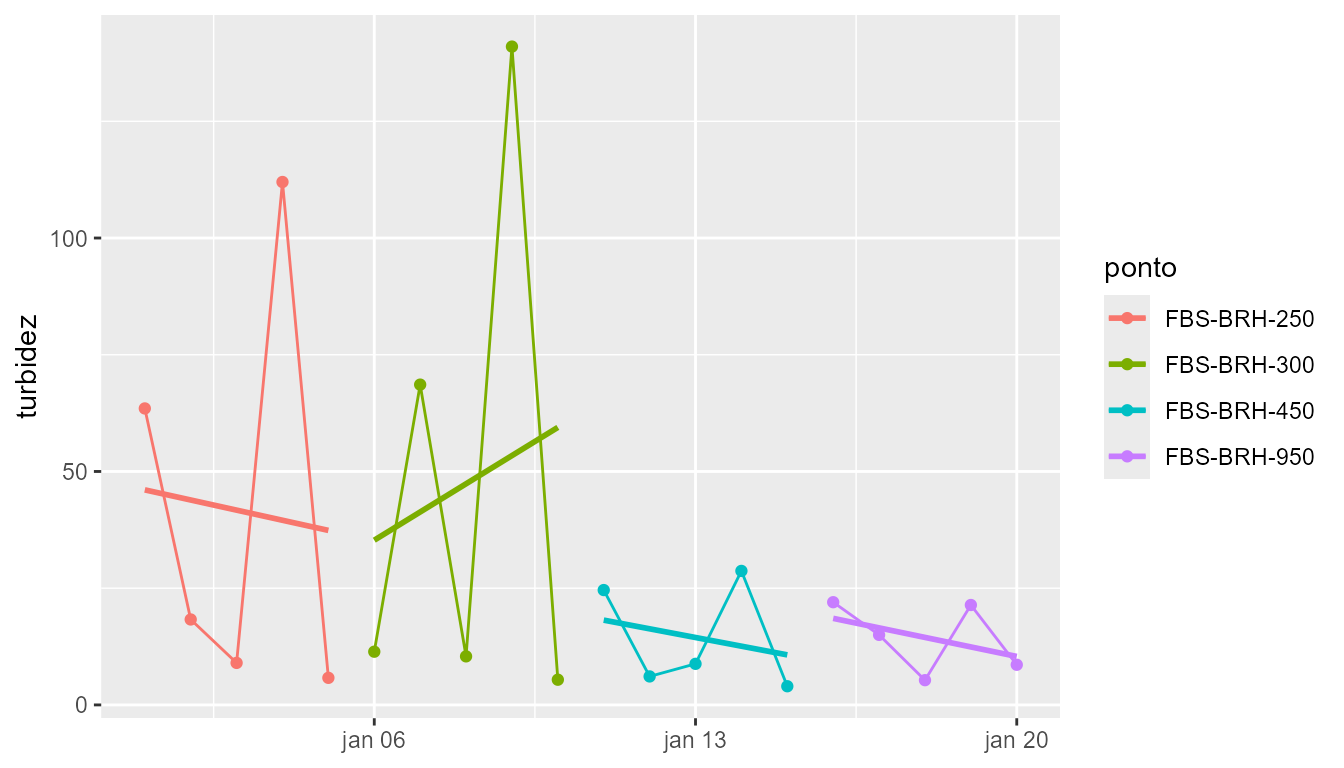
# Multi-parameter plot
p2 <- param_plot_multi(df_temporal, parametros = c("turbidez", "od", "dbo"))
print(p2)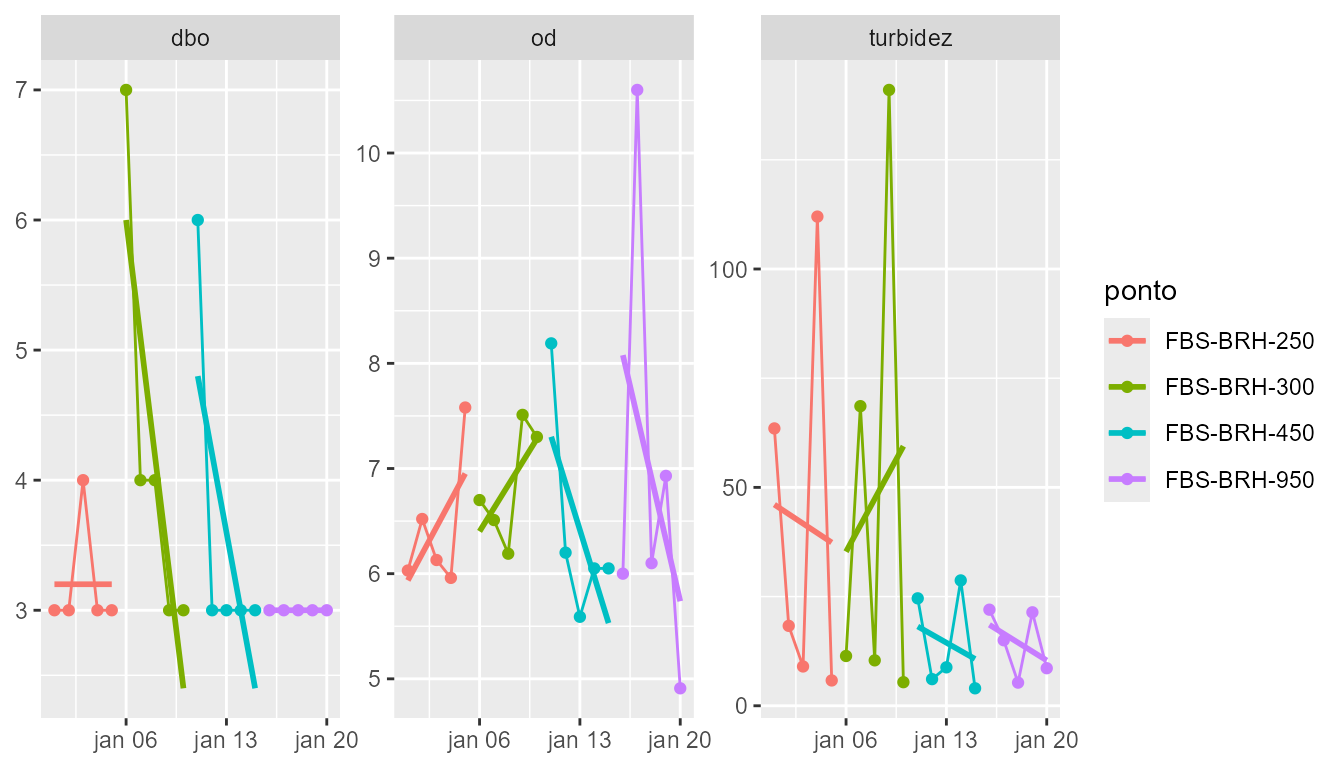
Statistical Methods
Best Practices
Choosing parameters for IQA
- Include all 9 default parameters when possible
- Use
na_rm = TRUEif some parameters are missing - Adjust weights only if you have domain knowledge
Handling censored values
- Use
nd_policy = "ld2"(default) for conservative estimates - Consider
nd_policy = "na"if censored values should not influence results - Document your choice in reports
Trend analysis
- Use Theil-Sen for robust estimates with outliers
- Require at least 4 observations per group for reliable trends
- Consider seasonal effects when analyzing temporal data
Units consistency
- Ensure all parameters use standard units (mg/L, NTU, etc.)
- Use
clean_units()to convert if needed - Document unit conversions in methodology sections
References
- Carlson, R. E. (1977). A trophic state index for lakes. Limnology and Oceanography, 22(2), 361-369.
- Lamparelli, M. C. (2004). Graus de trofia em corpos d’agua do estado de Sao Paulo: avaliacao dos metodos de monitoramento. Tese de Doutorado, Universidade de Sao Paulo.
- CETESB. (2021). Aguas superficiais: indice de qualidade das aguas (IQA). Companhia Ambiental do Estado de Sao Paulo.
Summary
This vignette covered:
- IQA calculation with default and custom weights
- Handling missing parameters
- IET methods for lentic systems
- Temporal trend analysis (Theil-Sen, Spearman)
- Parameter-specific analysis tools
For workflow examples, see the “From raw water quality data to CONAMA report” vignette.